SUNDAY HOMILY

JMJ - PENTECOST - May 11, 2008 (MOTHER’S DAY)

We celebrate today a great miracle: the outpouring of the Holy Spirit and the birth of the Church as she emerges from the upper room, pours out into the streets of Jerusalem, and proclaims, in a way that all could understand, the mighty deeds of God. The Holy Spirit had come, just as Jesus promised!

Fifty days before Pentecost, on the night of His resurrection, Jesus had said to His Apostles, “As the Father has sent me, so I send you.” Then He breathed on them and said, “Receive the Holy Spirit.”

He breathed in them. A breath is only a little wind. But a little wind in the mouth of God is a mighty thing, indeed. And with a little word He had created the universe. “Receive the Holy Spirit,” He said. And 50 days later, they received the fullness of that Gift, as a “strong driving wind filled” the place where they were, and “tongues as of fire…came to rest of each one of them.”

They left that place then, the place where they had been praying for nine days, and began to pray in the streets, in ecstatic prayer, in languages unknown to them – but in languages well known the crowd who heard them, because “each one heard them speaking in his own language.” And many in the crowd came to believe in Christ that day; because what they heard were not just “words,” but heart was speaking to heart.

The Holy Spirit had filled the hearts of the Apostles; and out of the fullness of their hearts, the Apostles spoke to the people. The Holy Spirit spoke to the people. And the Holy Spirit enabled the people to hear what He said, not just with the ears of their bodies, but also with the ears of their hearts – heart was speaking to heart.

This same Holy Spirit has been given to you and me. Wouldn’t it be wonderful if our hearts were just as filled with Him as the hearts of the Apostles were at Pentecost? And wouldn’t it be wonderful if we were as ready as the crowds to hear what the Holy Spirit had to tell us?

The miracle of Pentecost didn’t happen “out of the blue.” The Holy Spirit had been working very quietly and for a long time to prepare for that day. You might say He’d been working at it from the first day of Creation. And Christ, too, had been preparing the Apostles. On the night before He died, He promised not to leave them orphans; He promised to send them the Spirit of truth. And before He ascended into Heaven, He told them they were to be His witnesses everywhere, but first to go back to Jerusalem until they had been “clothed with power from on high.” And they did go back. And what did they do in Jerusalem? They prayed. They prayed together; and they prayed persistently, for nine days. They prayed in the ordinary way, the way in which we do, ordinarily; but they must have prayed, don’t you think, with wonderful expectation – and very much from their hearts?

If we prayed in the same way, perhaps God would move more powerfully in our lives, too. To pray, to pray together, to pray persistently together, to pray in the ordinary way (that is to say, in the way God allows us to pray), but to pray with great expectation and from the heart. If this is the way in which God prepared the disciples for Pentecost, couldn’t we expect that, in this same way, He might also prepare a New Pentecost – a fresh outpouring of the Holy Spirit in our own time?

This year Pentecost is also Mother’s Day. Did you know that there was at least one mother present at Pentecost? Saint Luke tells us in Acts, chapter 1, that “there were some women in their company, and Mary the mother of Jesus.” Mary was no stranger to the Holy Spirit. It was the Holy Spirit who had “overshadowed” her at the beginning of the Incarnation. It was the Holy Spirit who made her a mother; and it was Jesus, her Son, who gave her to us to be our mother too, the Mother of the Church.

Mary is the model disciple, the only disciple present from the beginning of the Incarnation to the gift of the promised Spirit at Pentecost. She is a model of faith, humility, courage, and surrender to the will of God. She is also a model of prayer – in her own ecstatic prayer of praise, which we call the Magnificat; and here too in the upper room, gathered with the others, praying in the ordinary way, but with great expectation and from the heart. What do you suppose Mary wanted for those spiritual children of hers? And isn’t what Mary wanted for them, what every Christian mother should want for her children, too?

Let me address a few final words to the mothers who are here at Mass today. Mary is a model for all Christians, men and women, boys and girls; but, perhaps especially, she is a model for mothers. Mothers, want for your children what Mary wants for them: Want what is truly best for them. Not necessarily the best education, or the biggest income, or the most prestigious job. Want instead -- and do more than just want it, will it and help bring it about -- that your children come to know, love, and serve the Lord, who has made them for Himself. Help them deeply to appreciate that, in addition to their bodies (which you helped to give them), they also have immortal souls, which are worth more than anything else they will ever possess. Teach them to pray. Help them to grow in holiness. Help them to understand the thing for which they were made. These are the greatest and most loving things you can do for them, and the things for which they will rightly honor you – today and for all eternity.


JMJ - ASCENSION – May 4, 2008

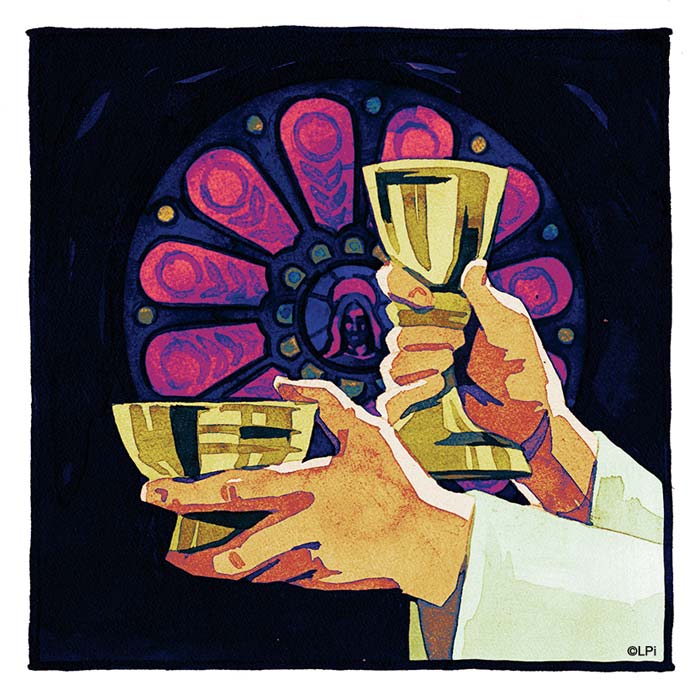
God is a Promise Keeper. Jesus promised to remain with us always, “until the end of the age.” And He is keeping that promise. One of the most beautiful, powerful, gratifying, and consoling ways He is keeping that promise is the Eucharist.

He is there in the tabernacle, keeping His promise. And today, He is going to live in new tabernacles – these children.

Why does He do that? Why does He come to us in Holy Communion? He does it because He wants to be close to us -- and because He wants us to be close to Him, and to one another.

When I was a little boy, I had a best friend. His name was Peter Dolan. I loved spending time with Peter – he was smart and used to help me with my homework. I loved spending time at Peter’s house; he had such a nice family. But I loved it even more when Peter could come to my house, and spend time with me there.

Children, for about seven years now, you’ve been coming to God’s house, to the place where God lives. Today, He is coming to your house; He’s coming to the place where you live: He’s coming into your hands, your mouths, your bodies. And you’ll be taking Him home with you, to be with your families. Give Him the love He deserves. And give to the others in your family some of the respect you would give to the tabernacle – because Jesus will be living in them, too.

Parents, take good care of these little tabernacles of yours. Their innocent minds and hearts are the dwelling place of God. He has given you a tremendous responsibility, a responsibility upon which you will one day be judged.

A priest has a sacred responsibility to protect the tabernacle in his church. God has also given a sacred responsibility to you. Protect these little ones, and guard their faith. Be to them as the sanctuary lamp is to the tabernacle here in the church. Let them see the lighted lamp of your own faith, and put it near them. Put it so near them that they can feel the warmth of your love for God, and for them.

This is a happy day in the life of our parish. Every Sunday is a happy day in the life of a parish, because it’s the day of days for Holy Communion. But this is a particularly happy Sunday – the day of First Holy Communion! May this first Communion be the first of thousands and thousands of Communions. May every one of them be worthy, and may every one of them be happy.


JMJ - SIXTH SUNDAY OF EASTER –April 27, 2008

The Lord speaks consolingly to His Apostles. He knows that He is soon to die, and so He tells them: “I will ask the Father, and He will give you another Advocate to be with you always, the Spirit of truth.” The Holy Spirit is our other Advocate, Christ’s “other self” we could say. He helps us to be like Christ: true sons and daughters of the Heavenly Father.

One of the ways in which the Holy Spirit helps us to become like Christ is to help us grow in Christ-like virtue. Now, Jesus possessed the fullness of all the virtues; but one of the most centrally important was the virtue of obedience: “Son though he was, he learned obedience from what he suffered” (Hebrews 5:8). The obedience of Jesus was absolutely crucial to our salvation – because without it, Christ would not have accepted the Cross: “Father, if it be possible,” He said, “let this cup pass away from me; yet, not my will but thine be done.”

Jesus came to understand, in His human nature (and by the guidance of the Spirit), that obedience to the will of the Father would entail His suffering and death. And also under the guidance of the Holy Spirit, you and I must learn that very same lesson. If we ever hope to be like Christ, we must learn the lesson of obedience through a very similar suffering.

What caused Christ to suffer? He suffered on account of the world, its cruelty and its indifference. But there was also, in the garden and on the Cross, the even greater suffering of the sensible absence of God. “My God, my God, why have you abandoned me?” He cried. None of us will ever suffer to the extent that Christ suffered, but we do experience something of the same sort of suffering. Don’t we, every day, experience something of the cruelty and indifference of the world? And don’t we at times also experience something of the “absence of God”? We wonder where He is when we need Him the most.

When bad things happen to good people, good people are sometimes tempted to blame God. Some people have even grown angry with God. They speak of His absence, or His indifference, or even of His cruelty. But how can He be absent who is everywhere? How can He be cruel who is All-good? How can He be indifferent who gave His Only Son? Still, the temptation is there. How to combat it? How to combat it when it’s our temptation?

The best way, I think, is to look at the Cross, to look awhile at Christ crucified, and to ask for the help of the Holy Spirit who so filled Him. Christ in His human nature, so filled with the Holy Spirit, never grew angry with the Father; and His last words on the Cross were full of confident love: “Father, into your hands I commend my spirit.” Would that we had such confidence! And we can with the help of the Holy Spirit.

God never promised us a rose garden – not in this life, at least. And He showed us by His own suffering and death what it was we should expect in this life. It was a crown of thorns He wore, and a cross that He carried. He came to show us the way: “I am the Way,” He said, “and the Truth, and the Life.” If we’ve never experienced life as a Way of the Cross, then maybe we’ve lost our way, and chosen the wrong road. Jesus said: “The gate that leads to damnation is wide, the road is clear, and many choose to travel it. But how narrow is the gate that leads to life, how rough the road, and how few there are who find it” (Matthew 7:14).

So if you and I, in our journey through life, are experiencing some “bumps in the road,” the very least we can do is not be too sad about it. It’s proof perhaps that we’re on the right road, the one that leads to Heaven.

May the Holy Spirit help us to be like Christ in all things, and may our sufferings one day bring us to glory.


JMJ - FOURTH SUNDAY OF EASTER - April 13, 2008

This Gospel of the Good Shepherd invites a reflection on the nature of love. What is love? How would you define it? St. Thomas Aquinas did it this way: he said, “To love is to seek the good of the other.” St. Thomas was a great student of the Bible; and, as all the saints do, he loved Jesus. So I wouldn’t be at all surprised if, when he defined love, he had today’s Gospel in mind, in which Jesus speaks of Himself as a shepherd who loves His sheep, and of the thieves who don’t.

“A thief comes only to steal and slaughter and destroy,” He said; “I came so that they might have life and have it more abundantly” (John 10:10).

A thief doesn’t love the sheep; he simply wants the sheep. He doesn’t seek the good of the sheep, but rather his own good. But Jesus seeks only the good of the sheep: “I came that they might have life and have it more abundantly.”

To seek the good of the other is so different from the direction we’re being pushed in every day. We’re caught, as it were, in a strong and deadly current. It’s the culture we live in: “Look out for No. 1,” the world says; and “Every man for himself.”

We’re called to leave that world -- or to convert it. We’re called to swim against the stream. To paraphrase G. K. Chesterton: “The world is converted by the saints who contradict it most.” You and I are called to be those saints, each one of us in his or her own place. As pastors, parents, and teachers; as doctors, nurses, and lawyers; as employers, managers, co-workers, neighbors, and friends – we’re called to be good shepherds of the flock: to put others first, to be humble and not proud; to be all the things St. Paul described as the characteristics of love: to be patient and kind; not jealous, conceited, or snobbish; never rude or self-seeking; not prone to anger or brooding over injuries. In other words, we’re called to be like Jesus. And to the extent that we try to be like Jesus, we conquer the world. We conquer it by contradicting it, by swimming against the stream.

Martin Luther King, Jr., once said: “Whom you would change, you must first love. And they must know that you love them.” The same thing applies to our relationship with the world. We must love the world if we’re going to convert the world, if we’re going to change it. But we must love the world, not as the world loves, but as Christ loves. We must love others, not as we love bacon and eggs, or pizza, or ice cream. We mustn’t love others simply for the sake of our own selves: because we want them. When we love things that way, the things we love disappear – we “slaughter and destroy” them. Where is that pizza about which I said: “Oh, that pizza! How I loved it!”? That pizza’s nowhere to be found -- because I consumed it, I destroyed it; it’s disappeared. No, we must love as Christ loved, even to the point of disappearing ourselves. “Greater love than this no man has than that he lay down his life for his friends.” We must love others, not for our sake, but for theirs.

It’s that sort of love that will conquer the world. In fact, it already has -- for He lives and reigns for ever and ever.


JMJ - THIRD SUNDAY OF EASTER - April 6, 2008

This Gospel story of the two disciples and their meeting with Jesus is one of my favorites. I’ve come to think of it as being especially our story – the story of our encounter with Jesus at every Sunday Mass.

As you remember, the story begins with the two disciples walking away from Jerusalem. They are confused and dispirited; they have separated themselves from the other disciples; and they have not yet met the Risen Lord. When they do first meet Him, they don’t recognize Him; although their hearts begin to “burn within” them as He explains the Bible to them. They become so intrigued that they ask Him to “stay with” them, which He does. And in the course of the meal they share, He “took bread, said the blessing, broke it, and gave it to them.” “With that,” St. Luke says, “their eyes were opened and they recognized him.” Whereupon He vanishes, and they return to Jerusalem to share the good news of how “he was made known to them in the breaking of bread.”

The “breaking of bread” was a common early Christian way of referring to the Mass. By the time St. Luke recorded this story, Christians had been celebrating the Mass for about 50 years; and it would have been very much in the form in which we celebrate it today. It began with the liturgy of the Word, in which the Scriptures were explained. This was to prepare the hearts of the hearers for the liturgy of the Eucharist, for the breaking of bread, in which the eyes of faith discern the real presence of the Risen Christ.

In other words, what happened to Christ’s disciples on the road to Emmaus is a description of what should be happening to His disciples every Sunday.

Sunday Mass is supposed to engage the whole person: our ears, our minds, our hearts, our faith, and our feet. Let me say a word about the feet.

Several years ago, I got a phone call from a young friend. I was in Muskogee at the time, and he lived in Tulsa. He said he wanted to come see me; there was something important he wanted to share with me. I said, “Would you like to talk about it on the phone?” “No,” he said, “it’s too important for that.” So I said, “Please come.” When he arrived, we went out for a bite to eat and to talk. The news he wanted to share with me, the news that was too important to talk about on the phone, was the good news that, with the help of a Catholic friend, he had finally come to understand what was meant by “transubstantiation” – and it blew him away! After all his years in Catholic schools and religious education programs, he had finally realized what it meant that Jesus was truly present – in His Body, Blood, Soul, and Divinity – under the appearances of bread and wine. And it blew him away.

Something similar happened to the disciples on the road to Emmaus: “Their eyes were opened and the recognized him.” And the news was so good that they had to share it with someone. They went back to Jerusalem – they used their feet, you see – to tell the others.

Two questions: Do we have any good news to share? And, are we sharing it?

Has the Lord ever walked with you in your life? Has your heart ever burned within you? Have you as yet fully realized His real presence in the Eucharist? And have you, as yet, shared that with anyone? And if you did share it, who did you share it with?

It is interesting to me that the two disciples in the Gospel story first went to share the good news with the other disciples. It’s exactly what my young friend did: he came to share the good news with me – a priest! Aren’t we supposed to share our faith with the unbelievers? Sure we are. We’re supposed to go into the whole world. But it doesn’t hurt to share our faith with other believers, too; sometimes they need it just as much as anyone else. It’s also good practice, to prepare us to share the faith with those who don’t believe. To use again the image of the feet: we must learn to walk before we learn to run.

Where do we get that practice in sharing our faith? Where do we find those other believers? Well, have a look around you! There are a lot of them here: in your own parish, and in your own home. And there are plenty of opportunities, every week and even every day: Bible study and small faith groups; and those daily opportunities in the home, to pray together and to share faith together. Have you ever told your son or daughter, your husband or wife, your mom or your dad, about how God has touched you and warmed your heart, or about how you came to recognize Jesus in the Eucharist? It would make an interesting conversation. Maybe a life-changing one.

Someone once said: “Most of us have caught a glimmer at least of what the saints were blinded by. Only, unlike the saints, we tend to go on as though nothing had happened” (Frederick Buechner). That’s not what those disciples did. And it’s not what we’re supposed to do, either.


Volunteer Job Descriptions Meet The Pastor Meet The Associate Pastor
Our Parish Staff Staff E-Mail Mission Statement
Registration Form History Of The Parish History Of St. Bernard
Our Stained Glass Windows Advent Calendar St. Bernards At A Glance
Standing Councils & Committees Mass & Confession Times Ministry Schedule
Youth News Weddings & Baptisms Annual Parish Report
Catholic Web Resources Weekly Bulletin Parish Council Meeting Minutes

You are visitor number

Thank you for visiting !

Designed By
Designs of Destiny

Hosted on

(c) 1999 - 2007